
 ▶
 ▶
Raising kids in Mérida
Raising Kids in Mérida: schools, safety and what it really costs
Raising kids in Mérida means free public school or private bilingual school from about $300 a month, a safety record that sits near the top of North America, and household help that most U.S. families cannot afford. This page puts real numbers next to New York, Chicago, Atlanta, Los Angeles and Washington, D.C., explains how the family residency process works, and shows you what to expect before you decide.
Written by the TBME team in Mérida, Yucatán. Numbers checked November 2026.The choice
Public, private or homeschool
If you are considering Mérida with children, the calculus is different than if you were doing this alone. Every question filters through a single lens: is this the right thing for my kids? Not just logistically, but emotionally, developmentally and socially.
Start with what Mérida offers. Public schools are available and free, though most expat families opt for private or hybrid models. And there's a robust and growing homeschooling community, with families organizing pod learning, cooperative education, and shared enrichment activities.
Think of school the way you think about groceries. It is a financial choice before it is anything else, and plenty of families mix and match. Some send a younger child to a private bilingual school and keep an older one in a pod. Some use public school for a year while their Spanish catches up. There is no single right answer, only the one that fits your child and your budget.
Public school
Free. Instruction is in Spanish, which makes it the fastest immersion and the steepest start for a child who does not speak the language yet.
Private bilingual
From about $300 a month. A Spanish teacher and a native English teacher share each classroom, so children keep up in both languages.
Homeschool and pods
Families share tutors, co-ops and weekly meetups. It works best when a parent has the time and a community to lean on.
Sources: Mexican Constitution, Article 3. TBME Relocation Data Brief, Q1 2026.
Older kids
Is high school free in Mexico?
Public school in Mexico is tuition-free, and high school is part of the public system. Article 3 of the Constitution says education the state provides is free, and the federal education ministry (SEP) treats upper secondary school, which includes high school, as compulsory. In Mérida that means your child has the same three choices at junior high and high school as at younger ages: public, private or homeschool.
Enrollment rules for a foreign student vary by school and by grade, so confirm with the school you are considering. We walk families through it in our live masterclass, and if you would rather have it handled, our concierge team works with schools on the ground to get children enrolled.
Safety
Safety comes first
Safety is the first question parents ask, so it gets the first chart. Mérida is ranked the safest city in Mexico and the second safest in North America (CEOWorld Magazine, 2024). The question we encourage you to ask is the one behind the question: compared to what?
People also ask whether Mexico is safe for families. Mexico is a large country and conditions differ sharply by region, which is why we talk about Mérida and Yucatán specifically instead of the country as a whole.
Here is the homicide rate per 100,000 people for the five U.S. cities families most often tell us they are leaving, next to Mérida.
Sources: Rochester Institute of Technology, Center for Public Safety Initiative, Working Paper 2025-02, for 2024 U.S. city rates. Mérida from TBME Relocation Data Brief, Q1 2026. Bars are drawn to one scale. U.S. homicides fell in 2025 according to the Council on Criminal Justice, so recent figures are lower than these. Other TBME pages may cite slightly different city figures because sources and years differ.
For families, one more number matters. Firearms are the leading cause of death for children and teens ages 1 to 19 in the United States (KFF, August 2025). Everytown for Gun Safety reports that Black children ages 0 to 17 are 13.6 times more likely to die by firearm homicide than their white peers.
The U.S. State Department rates Yucatán Level 1, "Exercise normal precautions," the same level it gives Australia and Japan. That does not make Mérida a place without crime or without common sense. Lock your door, learn your neighborhood and ask your community. It means the baseline is different, and parents tell us that is what they feel first.
Two of our Hive families talk about this directly: Terrence and Ciara in Is Mérida Safe for Black Families? and Kaysan and Stephanie in Raising Black Kids Safely in Mérida. Our full breakdown is on Is Mérida safe?
School
What school is actually like
The most significant thing about education in Mérida is not the structure or the cost. It is the culture inside the schools.
This is a culture of kindness. That phrase might sound soft, but parents who have experienced it describe it as revelatory. Bullying is an anomaly in Mérida's schools, not a rite of passage. Teachers genuinely love children, and children know it. The relationship between teacher and student is warm, affectionate, and characterized by mutual respect.
Your child still kisses you goodbye at drop-off in front of their peers, because that's normal here. Sarcasm, social hierarchy and one-upping are odd here, not currency. Parents consistently report seeing a different side of their children in Mérida. When the social pressure lifts, children become more themselves.
Children who grow up in Mérida also become bicultural. They learn Spanish alongside Mexican classmates, and they carry a worldview that is not bounded by American norms.
That is the experience reported by the families in our community. It is not a guarantee, and every school and every child is different, so visit before you enroll.
How bilingual schools work
The two-teacher model
Bilingual private schools in Mérida typically run a two-teacher model: a Spanish teacher and a native English teacher, with students spending about half the school day with each. Class sizes generally run 15 to 25 students. Schools in Mérida with bilingual or international programs include the American School of Mérida, Madison International School, Centro Educativo Piagetano, Alianz Multicultural School, Smartium, Rogers Hall and Ateneo de Mérida (TBME Relocation Data Brief, Q1 2026).
Plan ahead. Families typically enroll two to three months before the move, and tuition is only part of the bill. Budget a one-time enrollment fee of $500 to $1,500, uniforms at $100 to $300 a year, books and supplies at $200 to $500 a year, and optional school transportation at $50 to $150 a month. Tour at least two schools, ask about class size and ask what the first month looks like for a child who does not speak Spanish yet.
Source: TBME Relocation Data Brief, Q1 2026. Fees and school lists change, so confirm with each school.
The comparison
Tuition compared across cities
Families who are weighing Mérida are often weighing Panama City, Mexico City or somewhere in Thailand too, so here is how published private and international school tuition lines up. School pricing is published school by school, not tracked by any single index, so treat this as a snapshot of typical ranges rather than a ranking.
Two things stand out. Mérida's mid-range bilingual schools cost far less than the top international schools in Panama City or Bangkok. And the average U.S. private school costs more than most Mérida bilingual options, before you add the cost of living around it. We cannot give you a city-by-city U.S. private tuition table because that data is not published in a reliable, comparable form for New York, Chicago, Atlanta, Los Angeles or Washington, D.C. Tuition at private schools in those cities varies widely, and elite day schools can run far above the national average.
Bars use the midpoint of each range, scaled to $30,000. Sources: TBME Relocation Data Brief, Q1 2026 (Mérida). WhereNext, 2026, for well-regarded bilingual schools in Mexico City, a single source, so treat it as rough. ExpatSchoolGuide for Panama City across 13 schools, with top-tier elementary at $12,000 to $17,000 per iSchoolAdvisor, 2026. NIST International School tuition for 2026-27 in Bangkok, one of the city's priciest schools, converted at roughly 36 baht to the dollar, an assumption that moves with the exchange rate. Private School Review, 2026-27, for the U.S. average.
Public school in Mérida costs nothing in tuition, which is the other end of the same choice. If Panama is on your list too, Hive Ep 7 follows a Black expat veteran who weighed Mérida or Panama and walks through his residency story.
Childcare and household help
The line item that changes daily life
Domestic help in Mérida is abundant, affordable and culturally normal. Housekeeping, cooking, childcare, laundry and gardening are all part of how many middle-class households run. For working parents, this means something that barely exists in America: the ability to have a career and a family without choosing which one gets your scraps.
In Mérida a full-time nanny typically costs $400 to $600 a month and part-time childcare runs $20 to $40 a day. A weekly housekeeper is $15 to $30, and a Spanish tutor is $10 to $20 an hour (TBME Relocation Data Brief). Here is how that compares with center-based infant care in the five U.S. cities.
Bars are drawn to $2,500 and use the midpoint for Mérida. Sources: DayCareCalc, 2026, which builds city estimates from the U.S. Department of Health and Human Services Child Care Market Rate Survey with local cost adjustments, so treat them as estimates. Mérida from TBME Relocation Data Brief, Q1 2026. A nanny is a different service from a daycare center, shown here for scale. A full-time nanny in Atlanta runs about $2,750 a month and in Washington, D.C. about $4,600 (DayCareCalc, 2026).
Daily life
The childhood that's largely disappeared
Kids in Mérida play outside until dark. They ride bikes to friends' houses. They walk to the corner store. They exist in public space with a freedom that feels almost nostalgic to American parents, because it's the childhood most of us had in the '80s and '90s, before it slowly became impossible. Neighbors know each other's children. Shopkeepers recognize the kids who pass by daily.
Mornings
Slow mornings
A lot of families in the TBME community practice what they call "slow mornings." Instead of alarm, coffee, rushing everyone into clothes and fighting traffic, mornings are unhurried. Breakfast as a family. A walk. Time to be present before the day starts. Your kids aren't beginning every day in a cortisol storm.
This isn't because families in Mérida are unemployed or unambitious. It's because the infrastructure of life here, with shorter commutes, household help and walkable neighborhoods, gives families their mornings back.
After school
Excellence without pressure
The kids' extracurricular scene in Mérida is going to surprise American parents. Tennis, chess, art, swimming, music and martial arts are varied and affordable, typically $30 to $50 a month per activity. What stands out is the instructors. They're not babysitting. They're genuinely invested in equipping kids to be excellent, with real rigor and real standards, but through encouragement instead of the anxiety-producing dynamics that exhaust so many American families.
One Hive family, Kaysan and Stephanie, said soccer for their kids costs about $8 a month, compared with $300 or more for a single activity back in the United States.
Food
What your kids are eating
Since March 29, 2025, Mexico has banned the sale of junk food and sugary drinks in schools nationwide, public and private, covering ultra-processed foods and products carrying a black warning label for excess salt, sugar or fat (Associated Press, Mexico Business News). Compare that to the vending machines in your kid's hallway back home.
Outside school, the shift is equally significant. When your housekeeper or chef is cooking daily meals from mercado ingredients, such as fresh produce, real chicken and handmade tortillas, your kids' default diet changes naturally. Parents tell us their kids have more energy, better focus and fewer emotional meltdowns. The environment does the work, and you are not fighting your kids over food choices.
Health
When a child gets sick
Private hospitals such as Star Médica, Centro Médico de las Américas and Hospital Faro del Mayab serve families in Mérida, and a doctor visit typically costs $30 to $50, with pharmacy clinic visits as low as $3 to $22 (TBME Relocation Data Brief, Q1 2026). Most families pay out of pocket for routine care and carry insurance for the big events.
Community
Raising kids is better together
The WhatsApp group buzzes with playdates, school recommendations, pediatrician referrals and the thousand small questions that come with raising children in a new place. Mexican culture welcomes children everywhere, in restaurants, at events and at late dinners. Children are part of life here, not something you arrange your life around.
Every family in this community chose to be here. That shared choice creates families who are more open, more intentional about connection and more willing to show up for each other. Learn more about the TBME community.
The family budget
What a family actually spends
A three-bedroom house with a yard in a good neighborhood typically runs $1,200 to $1,800 a month. Add private bilingual tuition, activities, household help, groceries, healthcare and family outings, and families typically spend $4,000 to $6,500 a month. A comparable lifestyle in a major U.S. city runs $12,000 to $18,000.
The capital you free up goes into investments, experiences, education savings and building real wealth, while giving your kids a richer, freer, kinder childhood than what was available back home. For a line-by-line view, see the cost of living in Mérida and our comparison of Mérida against Atlanta, Houston and Chicago.
Bars use the midpoint of each range, scaled to $18,000. Source: TBME Relocation Data Brief, Q1 2026. Exchange rates, rents and tuition move, so build in a cushion.
Choosing a place
What part of Mexico is best for families?
Families ask us this all the time, and we will be honest that we are biased. Our work is built around Mérida, and here is why we say it.
Mérida is ranked the safest city in Mexico and the second safest in North America (CEOWorld Magazine, 2024). Yucatán's reported crime rate is about 235 per 100,000 people, compared with about 1,280 for Mexico as a whole (SESNSP, November 2025). The U.S. State Department rates Yucatán Level 1. For a family, that gap shapes everything: whether kids can walk to a friend's house, whether you let them play outside, how you feel when they are not in the room.
Mérida also has what families need beyond safety: bilingual schools, affordable household help, a walkable center and a community of Black families who have already made the move. The right place depends on your children's ages, your work and your budget, so we talk it through in the live masterclass instead of handing you a ranking.
Sources: CEOWorld Magazine, 2024. SESNSP, November 2025, via TBME Relocation Data Brief, Q1 2026. U.S. State Department travel advisory for Yucatán.
The Hive
Families who did it
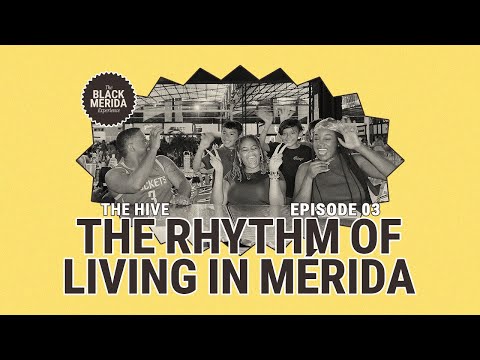
Numbers only go so far. These three Hive conversations are with parents who made the move with children, in their own words and in real time.
In the featured episode, Kaysan and Stephanie, a blended family with five kids, describe what changed once they stopped worrying about the move and started living in it. They visited in the summer of 2022 and moved within about two years. Their advice to anyone hesitating is to go for a few weeks or a few months and see for yourself.
The Hive, Ep 9, 24 minutes. Read the episode page.
 The Hive, Ep 4, 52 minutes
We Moved to Mérida With 4 Kids
A family of six from Houston on monthly costs, schools, childcare, safety and their marriage.
 The Hive, Ep 6, 23 minutes
Is Mérida Safe for Black Families?
An Austin couple on safety, daily life and a home birth in Mérida.
All episodesThe HiveBrowse the full podcast
Real stories from Black expats in Mérida.
Beyond school
Raising kids inside a community
School is only part of a childhood. The other part is who surrounds your children when the school day ends, and whether they feel known.
Black families in Mérida are building their own options. One school has started and another is on the way, and home pods meet across the community, with parents sharing tutors, teaching and weekly time together.
TBME does not run a school. We run programs for children: spring break, summer and winter break camps, with emotional skills built into every activity. Children are encouraged to believe in themselves and love themselves, and to set down what they carried from environments that made them feel small. Programming is designed so that neurodivergent children are in the center of the activity.
At the closing ceremony of Mérida's Youth Explorers Spring Camp in April 2026, a nine-year-old said, "When I got here four months ago, I was afraid to talk."
Our work with children comes from a bigger idea, which we lay out in Why We Build and in our Manifesto.
Spring Break Camp
Mérida's Youth Explorers Spring Camp, held in spring 2026, with a closing ceremony for families.
Summer Camp
The TBME Multicultural Summer Camp ran in 2026. Some campers visited from the United States while their families considered Mérida.
Winter Break Camp
Part of the same year-round rhythm of camps, so children have a place to belong when school is out.
Sources: TBME program pages and camp stories on Why We Build. Dates and offerings change, so check current programs with our team.
Moving to Mexico with kids
Moving the whole family
Moving alone is one set of paperwork. Moving a family of three or four is that paperwork multiplied by the number of people in your household. Each family member who stays in Mexico long term needs their own residency status, their own appointment and their own set of documents, and fees add up per person.
For temporary residency, the commonly cited financial test is about $4,400 a month in income, shown through six months of statements, or about $74,000 in savings held over twelve months (Mexperience, 2026, and consulate guidance). With children, consulates add a requirement for each dependent, and the exact amount varies by consulate and changes, so confirm the current figure with your consulate or attorney before you plan around it.
Here is what government fees alone look like by family size.
Assumes roughly $675 per person: a $56 consular fee plus the one-year Residente Temporal card at MXN 11,141, at recent exchange rates. This covers government fees only. It excludes attorney fees, translations, document legalization, medical or travel costs, and any lower family-unit rate you may qualify for. Source: Mexperience 2026 fee schedule. Fees and exchange rates change, so verify them with the Mexican consulate or a licensed attorney.
Why not DIY
Why families shouldn't wing it
For a single adult with clean documents, doing it yourself can be reasonable. For a family, the risk grows with every person on the application. A mismatched name on one birth certificate, a missing document for one child or a financial showing that falls short for a dependent can delay or derail everyone's file, and you may already have sold a house or signed a lease.
Families also run into issues that singles never see: consent or custody documents when both parents are not moving together, school records that need to be gathered and sometimes translated, tight deadlines after you arrive, and consulates that interpret requirements differently. If a child with Mexican residency later travels without a parent, a minor exit permit (SAM, MXN 294 in the 2026 fee schedule) may be required. An experienced Mexican immigration attorney is not optional for this, and that is why we work with a partner attorney.
Where it can cost less
Ways to do it cheaper, where it makes sense
Cheaper does not have to mean riskier. These are the places families commonly save, each worth confirming for your situation.
- File as one household on a single financial showing, instead of building a separate case for each person.
- Ask whether your family qualifies for the lower family-unit card fee. Mexperience's 2026 schedule lists half-price cards for family-unit applicants in some cases, such as the spouse of an existing foreign resident.
- Choose the right route first. Temporary residency can convert to permanent after four consecutive years, and picking the wrong category at the start can mean paying twice.
- Take a scouting trip before you commit to leases, school deposits or shipping. A few days on the ground can save thousands.
- Use a standalone legal consultation to scope the pathway, then decide how much help you want, instead of paying for a full-service package you do not need.
How TBME helps
Choose the level of support
Not every family needs the same thing, and most questions are easiest to answer in conversation. Start there. Some families then want a plan, and some want it handled. These are the ways we walk with families, from lightest to fullest.
Free live masterclass
Typically held about every three weeks and led by our Director of TBME Relocation Concierge. Bring your questions about schools, residency and kids. Join the live masterclass.
Your Mérida Relocation Roadmap
Our team builds the plan for your household and you carry it out. It credits toward the concierge if you move forward. See the options.
Residency Consultation
Our partner attorney maps the visa pathway, documents and residency card for every person in your family. It stands on its own. See the options.
Mérida Scouting Trip
Spend time on the ground, see neighborhoods, and look at schools before you decide. Plan a scouting trip.
TBME Relocation Concierge
White-glove, done for you: housing, school enrollment at any grade from elementary through high school, belongings, scouting and residency through our partner attorney, with our team on the ground. Explore the concierge.
Speak with an expert
Cannot wait for the next masterclass? Talk with someone on our team, or book an Ask Me Anything session. Book a call.
A note on timing
This page will be out of date
We checked the numbers on this page in November 2026, and we expect parts of it to be out of date within a year. Tuition rises. Exchange rates swing. Immigration fees and financial requirements are updated, and consulates change how they apply them. Crime statistics move too: homicides fell in many U.S. cities in 2025, which is why we show a dated snapshot and tell you where each number came from.
Use this page to understand the shape of the decision, then confirm the specifics that matter before you act: current tuition from the schools themselves, current fees and income requirements from the consulate or a licensed Mexican immigration attorney, and current prices from people living here now.
Questions
Questions parents ask us
Is it safe to raise kids in Mérida?
Mérida is ranked the safest city in Mexico and the second safest in North America (CEOWorld Magazine, 2024). Its homicide rate is about 2.5 per 100,000 people, compared with 21.7 in Chicago, 24.7 in Atlanta and 27.3 in Washington, D.C. (RIT, 2024 data for U.S. cities). No place is risk-free, so use common sense and ask your community. See how safe Mérida is.
Is public school free in Mexico?
Yes. Under Article 3 of Mexico's Constitution, education the state provides is free. Instruction is in Spanish, and most expat families choose private or hybrid models, which is a financial choice as much as an academic one.
How much does private school cost in Mérida?
Bilingual private schools typically start around $300 a month, which works out to about $3,600 a year, and top international schools run $8,000 to $12,000 a year (TBME Relocation Data Brief, Q1 2026). Budget a one-time enrollment fee of $500 to $1,500, plus uniforms, books and optional transportation.
How does Mérida school tuition compare with Panama City, Mexico City and Bangkok?
Typical Mérida bilingual tuition of $3,600 to $7,200 a year sits below the top international schools in Panama City, which can reach about $20,850 a year, and well below Bangkok's top international schools at roughly $18,000 to $31,000. Mexico City's bilingual private schools are reported at $2,000 to $5,000 a year by one source. The U.S. private school average is $13,779. See the tuition chart.
Can my child go to school in Mérida without speaking Spanish?
Bilingual private schools use a two-teacher model with a Spanish teacher and a native English teacher, and families in our community report that children learn Spanish alongside Mexican classmates. Public school is taught in Spanish. Ask any school what the first month looks like for a child who is new to the language.
Can I homeschool in Mérida?
Many families do. There is a robust and growing homeschooling community with pod learning, cooperative education and shared enrichment activities. One Hive family describes a pod that shares tutors and holds a weekly play night. Watch their Hive episode.
How much does a family spend each month in Mérida?
Families with children typically spend $4,000 to $6,500 a month in Mérida, compared with $12,000 to $18,000 for a similar lifestyle in a major U.S. city (TBME Relocation Data Brief, Q1 2026). See the cost of living breakdown.
How much does childcare cost in Mérida?
A full-time nanny typically costs $400 to $600 a month and part-time childcare runs $20 to $40 a day (TBME Relocation Data Brief, Q1 2026). Center-based infant care in the United States averages about $1,250 a month in Atlanta and $2,200 in New York City, according to 2026 estimates from DayCareCalc.
Is high school free in Mexico?
Public school in Mexico is tuition-free, and high school is part of the public system under Article 3 of the Constitution. In Mérida your child can choose public, private or homeschool at every level, including junior high and high school. Enrollment rules for a foreign student vary by school, so we cover the details in our live masterclass and our concierge team handles enrollment for families we work with. Join the live masterclass.
Do I need permission to take my child to Mexico?
Mexican consular guidance says foreign minors traveling alone or with someone other than a parent need a consent letter from their parents, while minors traveling with at least one parent generally do not. If one parent is traveling alone with a child, many families still carry a notarized letter from the other parent as a precaution. Rules differ for children with Mexican residency and for departures, so confirm current requirements with the Mexican consulate and your airline, and bring your questions to our live masterclass. Join the live masterclass.
What part of Mexico is best for families?
We are biased toward Mérida. It is ranked the safest city in Mexico and the second safest in North America (CEOWorld Magazine, 2024), Yucatán is rated Level 1 by the U.S. State Department, and families in our community find bilingual schools, affordable household help and other Black families already here. The right place depends on your children and your budget, so we talk it through in our live masterclass. Join the live masterclass.
What does TBME offer for kids?
TBME does not run a school. We run spring break, summer and winter break camps with emotional skills built into every activity, and Black families in the community are building schools and home pods of their own. For families who move with us, our concierge team handles school enrollment. Explore the concierge.
Does every family member need residency?
Each family member who stays in Mexico long term needs their own residency status, with their own documents, and government fees apply per person. Approximate fees for temporary residency come to about $675 per person before legal costs. Confirm current fees and requirements with a consulate or a licensed Mexican immigration attorney. See how TBME helps with residency.
When should we enroll our kids in a Mérida school?
Families typically enroll two to three months before the move. Tour at least two schools, ask about class size and ask how the school supports a child who is new to Spanish.
Will this information still be accurate next year?
Parts of it will not be. Tuition, exchange rates, immigration fees, income requirements and crime statistics all change. This page was checked in November 2026, so confirm current figures with schools, the consulate or a licensed attorney before you act.
Next step
You do not have to figure this out alone
Start with the free live masterclass, or take the short quiz to see where your family is in the decision. Either way, someone who has done this will walk with you.
You are not running from something. You are walking toward something.
Sources
Where the numbers come from
- TBME Relocation Data Brief, Q1 2026, for Mérida tuition, enrollment costs, household help, family budgets, healthcare costs and the list of bilingual schools.
- Rochester Institute of Technology, Center for Public Safety Initiative, Working Paper 2025-02, for 2024 homicide rates in New York City, Los Angeles, Chicago, Atlanta and Washington, D.C. Council on Criminal Justice, year-end 2025 report, for the decline in U.S. homicides in 2025.
- CEOWorld Magazine, 2024, for Mérida's safety ranking. U.S. State Department travel advisory for Yucatán.
- KFF, August 2025, on firearms as the leading cause of death for U.S. children and teens ages 1 to 19. Everytown for Gun Safety, on firearm homicide among Black children.
- DayCareCalc, 2026, built on the U.S. Department of Health and Human Services Child Care Market Rate Survey, for U.S. city childcare costs.
- Private School Review, 2026-27, for the U.S. average private tuition. ExpatSchoolGuide and iSchoolAdvisor, 2026, for Panama City. NIST International School, 2026-27, for Bangkok. WhereNext, 2026, for Mexico City.
- Mexico's Constitution, Article 3, on free public education, and the federal education ministry (SEP) on upper secondary school as compulsory. Mexican consular guidance on minors traveling to Mexico.
- SESNSP, November 2025, via TBME Relocation Data Brief, for Yucatán and national crime rates.
- Mexico's Constitution, Article 3, again, on free public education. Associated Press and Mexico Business News, on the national school junk food ban that began March 29, 2025.
- Mexperience, 2026 fee schedule and financial requirements, and Mexican consulate guidance, for residency fees and income or savings tests. Verify all of these with a consulate or licensed attorney before acting.
- The Hive podcast, Episodes 4, 6 and 9, for the family experiences described.