


What It Actually Costs to Live in Mérida — and What That Frees Up
The headline number: living in Mérida costs 50–60% less than comparable U.S. cities for a similar or better quality of life. But if that’s all you take away, you’re missing the real story. The cost of living in Mérida isn’t interesting because it’s low. It’s interesting because of what the margin creates.
When your monthly overhead drops by thousands of dollars, what changes isn’t just your bank balance. It’s your options. The investments you can make. The risks you can take. The time you get back. The experiences you can afford. The version of your life that becomes possible when money stops being the thing that constrains every decision.
This isn’t about living cheaply. The people relocating to Mérida through TBME aren’t downsizing their lives. They’re upgrading them — and spending less to do it.
Housing: What Your Money Actually Buys
Housing is where the math gets dramatic. A one-bedroom apartment in a desirable Centro or Santa Ana neighborhood runs $500 to $800 per month. A two-bedroom near Parque de Santa Ana or Paseo de Montejo: $900 to $1,500. A three-bedroom house with a yard in a family-friendly area: $1,200 to $1,800.
For comparison: a one-bedroom apartment in Atlanta averages $1,750. In Austin, $1,600. In Washington D.C., $2,300. In Chicago, $1,900. In Mérida, the same budget that rents you a basic apartment in an average American neighborhood gets you a colonial home with 14-foot ceilings, a courtyard, and character that doesn’t exist in American construction.
For buyers, the math is even more compelling. Properties in prime Centro neighborhoods range from $150,000 to $350,000 for beautifully renovated colonial homes. In American cities, that same money might cover a down payment. Here, it buys the whole house — and the property values in Mérida’s historic center have been appreciating steadily as the city’s profile grows.
Daily Living: The Details That Add Up
The day-to-day cost of living is where the quality of life argument becomes undeniable. Dining at a good local restaurant costs $5 to $8 per person. A mid-range dinner for two with drinks: $25 to $40. A month of groceries for a single person, shopping at the mercado and local stores: $150 to $250. For a family: $300 to $500.
Transportation costs are minimal. Taxis average $3 to $5 for most in-city trips. Many residents don’t own cars at all — Centro is one of the most walkable environments in North America. High-speed internet runs $25 to $40 per month. A gym membership: $20 to $40.
And then there’s the line item that changes daily life more than any other: household help. A housekeeper costs $15 to $25 per visit. A personal chef or regular cooking support is accessible at rates that would be unthinkable in the U.S. Childcare, gardening, home maintenance — all of it is available at a fraction of American prices. This isn’t a luxury reserved for the wealthy here. It’s a normal part of how life operates, and it frees up hours every week that Americans typically spend on domestic logistics.
Monthly Budget by Lifestyle
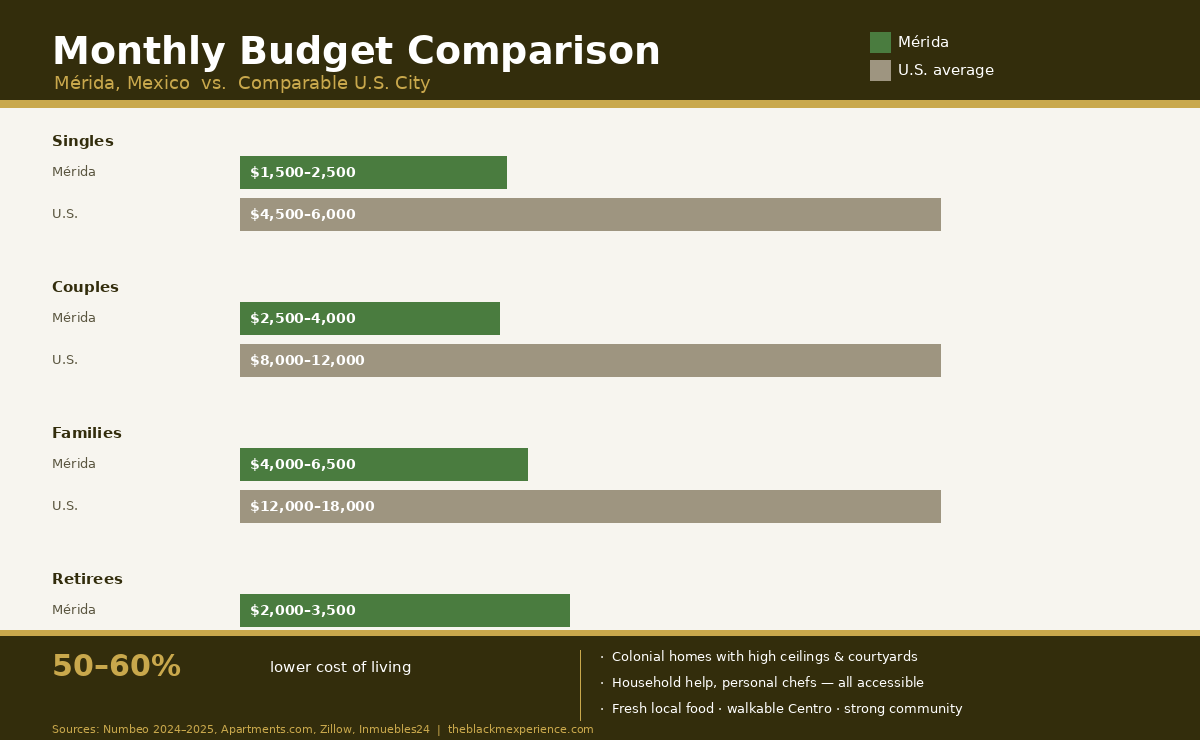
Singles: $1,500 to $2,500 per month for a comfortable lifestyle with a nice apartment, regular dining out, entertainment, gym, and transportation. The comparable lifestyle in a major U.S. city runs $4,500 to $6,000.
Couples: $2,500 to $4,000 per month for a beautiful two-bedroom, regular dining out, weekend trips, household help, and a full social life. Comparable U.S. cost: $8,000 to $12,000.
Families: $4,000 to $6,500 per month including private bilingual school tuition, a three-bedroom home, domestic help, activities for kids, healthcare, and regular family outings. Comparable U.S. cost: $12,000 to $18,000.
Retirees: $2,000 to $3,500 per month for a genuinely luxurious retirement — beautiful home, healthcare, household help, dining out, cultural activities, and leisure. Comparable U.S. retirement: $5,000 to $8,000 for a similar quality of life.
Healthcare Costs: A Category of Its Own
Healthcare deserves its own line because the savings are so significant. A general practitioner visit costs $20 to $40 — walk in, no referral, no insurance dance. A specialist consultation: $40 to $50. A comprehensive physical with bloodwork: $50 to $100. Dental work runs 60–70% less than U.S. prices. And the care is often better — 45-minute appointments where doctors actually examine you.
Coverage options include IMSS (Mexico’s public system, approximately $500 to $1,100 per year), private insurance ($100 to $200 per month), or pay-as-you-go for routine care. At $30 to $50 per doctor visit, many residents pay out of pocket for routine care and carry insurance only for catastrophic events.
Food Quality: The Hidden Health Dividend
One cost-of-living factor that doesn’t show up in any spreadsheet: the food quality in Mérida is transforming people’s health, which reduces healthcare costs over time. Community members report food sensitivities reducing or disappearing, weight dropping without dieting, increased energy and mental clarity — all because the food here is less processed, fresher, and made from ingredients that haven’t traveled 2,000 miles in a refrigerated truck.
When your daily meals come from the mercado and your personal chef is cooking with ingredients that were in the ground that morning, the default diet shifts. Not through willpower or restriction — through environment. That’s a cost savings that compounds over years.
What’s NOT Cheaper
Transparency matters: not everything costs less in Mérida. Imported goods, certain electronics, and American brand-name products are often more expensive. Electricity in summer months can be significant — Mérida is hot, and air conditioning is non-negotiable for most expats. If you stock your kitchen exclusively with imported American products, your grocery bill reflects it.
The key is adaptation. Residents who lean into the local economy — mercado shopping, local restaurants, Mexican brands — find the savings dramatic. Those who try to replicate an American consumer lifestyle with imported products will still save, but less dramatically.
What the Margin Creates: The Real Story
The point of this post isn’t that Mérida is cheap. It’s that the cost-of-living drop creates a margin — and that margin changes everything about how you live.
It’s the freedom to downshift your work hours because you don’t need to earn at the same level to maintain your lifestyle. It’s the capital to invest in real estate, in a business, in assets that appreciate. It’s the breathing room to take a creative risk, to write the book, to launch the project. It’s the luxury of time — slow mornings, unhurried meals, hours spent with friends and family instead of commuting.
For couples, it’s the ability for one partner to go independent or start a business while the other maintains steady income. For families, it’s private school plus domestic help plus a beautiful home for less than rent alone cost in Atlanta. For retirees, it’s a luxurious life that doesn’t require drawing down savings at an unsustainable rate.
Your money works harder here. But more importantly, you don’t have to.
Ready for the full picture? Watch our complete relocation guide.
TBME® PREMIER RELOCATION CONCIERGE
Sources: Numbeo 2024–2025, Pacific Prime 2024–2025, Western Union 2025, Apartments.com, Zillow, Inmuebles24, IMSS