




This Is Why
In 1824, a group of Black Americans who had bought or escaped their own freedom sailed from Philadelphia to a peninsula on the island of Hispaniola, in what is now the Dominican Republic, called Samaná. Two hundred years later, some eight thousand of their descendants still call themselves Samaná Americans. They still worship in the church their ancestors built, and some still speak the English their ancestors carried onto that boat.
In 1847, freed Black Americans who had crossed an ocean declared a republic of their own on the west coast of Africa. They called it Liberia. It is the oldest republic in Africa.
In 1852, a group of Black Americans who had escaped slavery crossed into a country that had abolished it twenty-three years earlier, under a president of African and Indigenous descent, and founded a town called El Nacimiento. Mexico granted them land in exchange for defending its northern frontier. Their descendants still hold the title to it today.
Three different doors. Three different centuries. Three different things won: a faith and a language, a republic, a title to land. One decision, made over and over, by people who understood something long before it had a name: that leaving is not the same as losing.
We recognize that same thing in you.
We know it because we lived it. Because everyone in this community lived it. Because millions of Black Americans are living it right now and calling it normal.
When was the last time you felt safe in your body? Not safe because nothing happened today. Safe in the ongoing way. Shoulders down. Jaw unclenched. Not already bracing for whatever comes next before it comes.
When was the last time you did not have to make yourself a little smaller so someone else could feel more comfortable?
If you had to think about it, that is the answer.
There are words we all know. Love. Freedom. Safety. We use them every day. Most of us have never actually felt what they mean, only what they sound like.
We are not here to add another entry to a record that has already been written in exhausting, well-documented detail. We are here to name it once, clearly, and then do something about it.
You already know something is wrong.
Not broken. Wrong. There is a difference. Broken implies it was once working for you. What you are feeling is the weight of a system operating exactly as it was designed, just never designed with your flourishing as the goal. The traffic is not broken. The headlines are not broken. The school, the grocery store, the paycheck that arrives and disappears before you can breathe, none of it is broken. It is working perfectly for someone. Just not for you.
The same constitution that promised you freedom counted our ancestors as three fifths of a person when it was written. They have been rounding up ever since.
You felt it in the grocery store when you flipped over the label and put it back on the shelf. You felt it when you watched another video you did not want to see. You felt it when you kissed your child goodbye at the school door and spent the rest of the day waiting for a notification you prayed would never come. You felt it in your body, in your bones, in the quiet moments when nobody was watching and you finally let yourself hear the voice you had been silencing for years.
Am I really going to spend my entire life like this?
Is this the country I am going to let raise my children?
Is this the best I can do, or just the most I have ever been told to expect?
For Black Americans, those questions carry a particular weight. Because we were already carrying more. The weight of a country that built its wealth on our labor, crowned our culture, and still found ways to keep us out of the rooms where the real decisions are made.
And still, most of us stayed. We marched. We voted. We built. We fought. We kept faith with a country that kept testing ours.
Here is what is strange about that.
The same person who would walk off a job the moment they were disrespected. Who would end a relationship the first time a real line was crossed. Who would stop a stranger mid-sentence and say, without flinching, without apology: you will not speak to me that way.
That same person could not bring themselves to consider leaving a country that had been crossing every line for four hundred years.
A therapist might say that remaining in a relationship that repeatedly harms you while calling it loyalty looks like trauma bonding.
A psychiatrist might say that fighting for an institution that systematically works against your survival looks like Stockholm syndrome.
A psychologist might say that holding two contradictory truths at once, this country is mine and this country was never built for me, without ever resolving the tension between them, looks like cognitive dissonance.
Now ask a Black American why the same government that will arrest two men for fighting in the street with their fists will hand those same men a uniform and send them to kill strangers on behalf of a country that has never fully protected them at home. Why they stand for an anthem written by a man who owned them. Why they keep faith with a democracy that has never fully kept faith with them.
And watch them pause.
That pause has a name. And this manifesto is it.
Two of the greatest minds in Black American history stood on opposite sides of that door. And both of them were right.
Frederick Douglass said stay and fight. His position was unshakeable: Black Americans built this country with their hands, their blood, their genius, and their grief. America owed a debt it had never paid. Leaving, he believed, played into the hands of the people who wanted us gone. The fight belonged here, on this soil, until justice was won.
Marcus Garvey said the fight was already decided. His position was equally unshakeable: no people had ever won their full humanity by waiting for their oppressor to grant it. Black Americans needed their own land, their own economy, their own institutions, their own flag. Build something that does not require anyone's permission to exist. He was called dangerous. Extreme. Crazy.
He was early.
Both men loved their people with everything they had. Both men were responding to the same wound with different medicines. Both positions live inside Black America today, sometimes in the same household, sometimes in the same person on the same afternoon.
TBME does not ask you to choose a side in that argument. We understand both. We honor both. We are simply opening a door for the ones who are already moving toward it.
The founders of TBME came to this vision from different directions, through lives that converged on a single purpose.
One grew up inside a community ecosystem in Brooklyn, New York, rooted in a church whose leadership carried a vision that expressed itself across every dimension of human need. Daycare centers where children were formed. Employment programs where families earned and built stability. Foster care networks where children who needed homes found them within the same community of people. Housing for men who had nowhere else to go. Healthcare. Legal services. Eventually, programs for asylum seekers and migrants arriving in America, people crossing borders looking for the same thing this founder would one day cross a border to find. A soft landing. A community. A chance.
It was one vision, carried by one leadership, expressed across an entire neighborhood. A child could grow up inside that ecosystem from the time they were two years old and never fully be without it. This founder was raised inside it. Employed by it as a teenager. Shaped by it in ways that took decades to fully name.
The other founder came to this vision through movement. A childhood spent living across the world, including years in Germany, where she noticed early, before she had language for it, that the bread tasted different, that the way families ate and lived carried a wholeness that felt important even to a child who could not yet explain why. She carried that knowing into adulthood, and she watched the American environment, its food, its stress, its medicine, work against everything she had sensed as a child. The wellness vision became non-negotiable. Not a program. A founding principle: healing is not something you pursue after the damage is done. It is something you build your whole environment around from the beginning.
The first founder lived the Douglass model as a child, inside a system built to stay and repair from within. Today, that same founder is building the Garvey model, something new, outside the system entirely. Same love. Different method. Not a contradiction. An evolution.
Both of them paid a price for the door they chose.
Freedom charges interest. Delay it and the price climbs. Some pay with the pain of leaving. Others with the pain of being left behind. No one escapes the bill.
That bill did not start with us.
Two hundred years later, we are still following the same instinct. The address has changed. The decision has not.
Black Americans buy homes in the United States. We hold deeds. But we have never owned land the way a people owns land: together, across generations, in a way that is passed down and cannot be taken. So when someone says Mérida is foreign soil, we agree with them. We are guests here, and we say so. But the honest question is: compared to what?
Two years ago, our family left.
People called us crazy.
We were not crazy. We were early.
Garvey heard that word too.
Because now the dam is breaking. The things we believed were coming are here now. And the people who watched us leave with pity in their eyes are watching us now with something that looks a lot more like longing.
The crazy family became the lucky family.
We did not get lucky. We decided.
There is a park two blocks from our home in Mérida called La Plancha. It stretches across multiple city blocks. Playgrounds, a bike trail, fountains that dance to music, an outdoor theater, and lights on every night of the week.
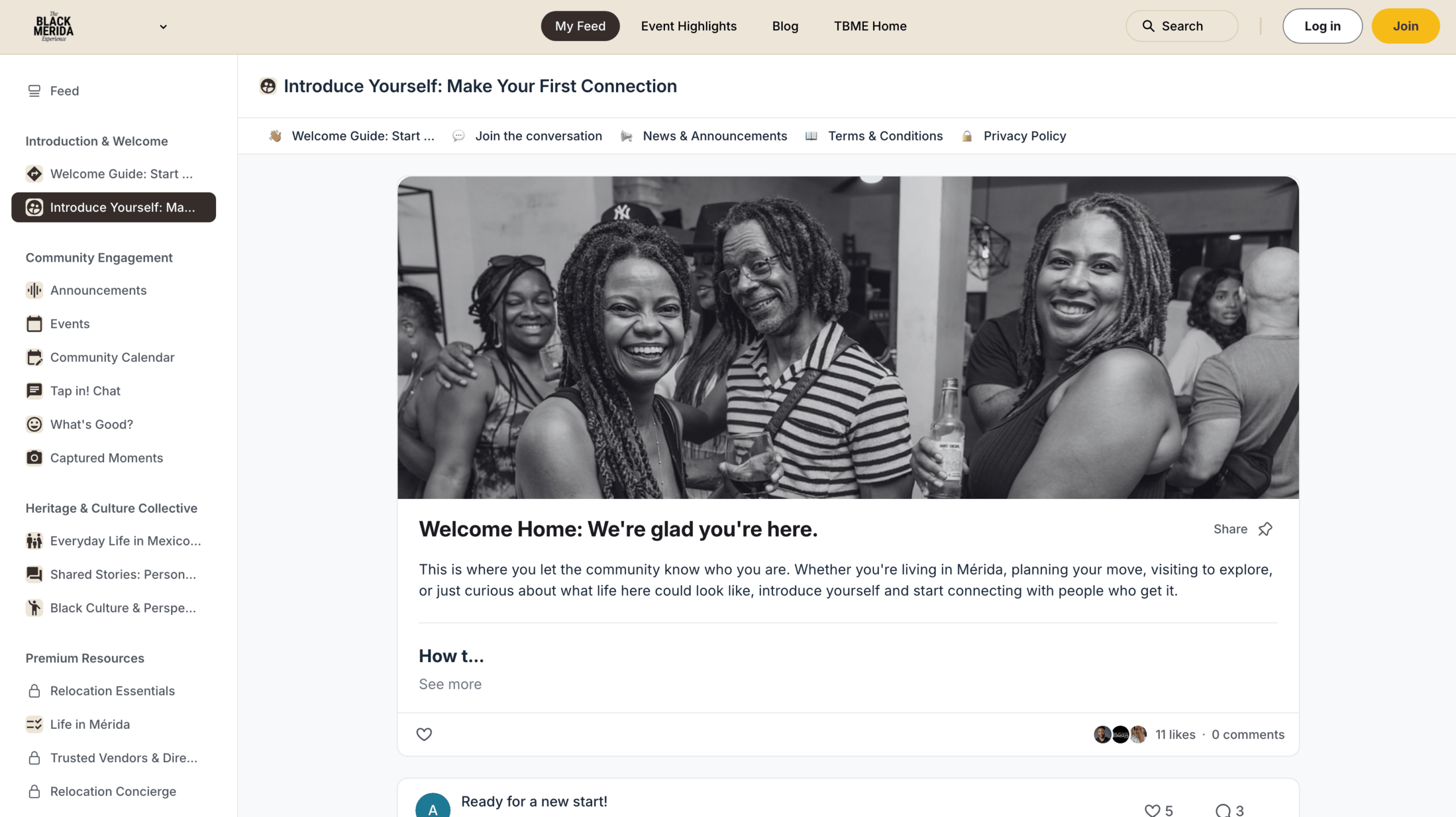
We walked it as a family one of our first evenings here. We met two other Black women and their children two blocks from our front door.
That was the beginning.
As more Black families arrived through 2024, they found each other. The question became simple: why don't our kids meet at La Plancha? La Plancha became the place.
Thursday evenings. Free. Always. From the very first one.
We are not the first people to cross a border on purpose. Every great migration in human history that produced something lasting did not succeed because people left. It succeeded because people built.
Black Wall Street was not just a neighborhood. It was an ecosystem. Black-owned banks, hospitals, schools, theaters, law firms. A dollar that, by some accounts, circulated within the community more than a dozen times before it ever left.
Then they burned it down.
We built it again.
They found other ways to dismantle it.
And so for generations, we have started over. New mortgage. New debt. New student loans. No land changing hands. No wealth compounding across time. No inheritance except the instructions to work harder and hope for better.
That ends here.
Relocation without community is just a change of address.
We are building for us. By us.
We need to be honest about what we are healing from. Because it is not abstract.
We are healing from a food system compromised so many times over that our bodies forgot what clean felt like. From a pharmaceutical industry that found it more profitable to manage our conditions than to address their causes.
We are healing from the school door you already know, and the fear that waits there all day.
We are healing from road rage, from invisibility, from the smallness we already asked you about.
We are healing from financial systems built to keep us producing and never quite arriving.
But we are also healing from something that does not have an easy name. The internalized voice that sounds like your own but was never yours. The unkindness we learned from being unkindly treated. The competition installed in communities where resources were deliberately kept scarce. The rage that had nowhere to go. The grief that never had a funeral.
Before we can build the next generation up, we have to be honest about what we are bringing with us across the border. The work is not just geographic. It is internal. It is the mirror that quiet finally makes possible.
Here in the stillness of Mérida, people are doing that work. Seeing themselves clearly, some for the first time. Discovering that what looked like laziness was something that never had room to surface. That what looked like anger was grief that never had a funeral.
That is the mirror we keep asking each other to look into.
The environment does that work. TBME walks alongside it.
And here, finally, is the answer to the questions we asked you at the start.
Here is what it feels like when the weight lifts.
The police here say good morning. They ask where you are from. They say bienvenido. The first time you pass an officer in Mérida and realize your body did not brace, that the calculation did not run, something shifts so quietly and so completely that it takes a moment to name what just happened.
You had forgotten what that felt like.
Affordable healthcare brings us joy. A stranger saying buenos días on the street brings us joy. Watching a Mexican grandfather walk his grandchildren through the park at nine at night brings us joy. We celebrate every birthday that falls in the same month, together, at the park. We watch people find this community and ask, immediately, where can I help.
That is joy we did not know we were allowed to want.
In America, some of the most abundant fruit trees we ever stood beneath grow at the California State Capitol.
We walked through that park in 2017, on the day we first met, long before either of us knew what the other would become. Orange trees, heavy with fruit. Small green signs staked into the ground beneath them: do not pick the fruit. We could not stop staring. Forbidden.
In 2023, the trees were still there, still full of fruit. In 2026, we went looking to see if we had imagined it. CapRadio, Sacramento's public radio station, had reported it in 2020: what falls from those trees goes to the compost, not to a food bank.
It is not only there. Many American cities planted ornamental trees so that nothing would bear fruit. In 2012, NPR reported on people in the San Francisco Bay Area who secretly grafted fruit branches onto those barren trees at night, because city officials said fruit trees on sidewalks were not allowed. A country that could not decide whether its own abundance was a gift or a liability, and for a long time chose liability.
We remember exactly how strange that felt then. And we remember, just as clearly, how different it feels now.
There is a mango tree in our backyard here. There is a lime tree that, in September 2026, sprouted limes for the first time. We do not wait for the fruit to fall and sweep it away. We pick it ourselves, and on Thursday evenings we carry what we picked to La Plancha, the same park where this all began, and hand it to whoever just arrived.
Not the word. The thing.
The same thing we do with a mango on a Thursday, we do with a full meal every Monday.
We are not going to pretend everything here is easy. That would not be honest, and honesty is the only thing we have ever promised you.
You cannot drink the tap water here. You could not always trust it back home either.
The power goes out sometimes, without warning and without apology. For people who left a life built on go, go, go, the first instinct is to reach for a phone, check a screen, do something, anything, so the feeling of being unproductive goes away.
Let that instinct pass.
People fly to Tulum and pay for a room with no signal, no schedule, nothing to check, because someone has to force them to stop or they never will. Here, the lights just go out. No flight. No resort fee. For twenty minutes, nothing in the world is asking anything of you.
That is not an inconvenience. That is the vacation people travel here looking for, arriving on its own, uninvited, for free.
The heat is real, though if you are coming from Texas, Florida, California, Georgia, or any of the other hot states, you already know how to carry it.
And everything here moves slower, most of all at the end of a meal. You finish eating. The table gets cleared. Nobody brings you the check. You have to ask for it, la cuenta, and until you do, nobody is coming to rush you out. In the United States a restaurant needs to turn that table, time is money, so the check arrives before you are ready for it. Here, nobody makes money by hurrying you out the door.
None of this is a complaint. It is an adjustment. And most of what we came here to heal from started with things that moved too fast for anyone to notice they were hurting us.
We have already started building what holds all of this.
The Kitchen did not begin as a TBME program. It began with a few families in this community who were short on food and refused to stay that way, so they cooked together and fed each other. When the goodwill ran out and nobody else stepped up, TBME was the last one asked. TBME said yes.
Now, every Monday, a professional chef cooks a hot meal, braised chicken or pork with rice, beans, and vegetables, and it reaches the door of every family who told us they needed it that week. The founders of TBME pay for the chef and the supplies. The community covers the food when it can.
One woman signed up during a medical leave, when there was no other way to keep her family fed. As soon as she was back at work, she started giving to the fund that had fed her. What held her that season, she now holds up for someone else. That is the whole design.
Then summer came, and our home filled with thirty children. The TBME Multicultural Summer Camp.
Black children. Biracial children. A Korean child. A Mexican child.
They swam. They boxed. They danced. They learned sign language and Spanish. They cooked and they baked. They went on field trip after field trip and came home exhausted and ready to eat again.
And in the middle of all of it were the neurodivergent children, some of them there for the first time in their lives. Some of their parents told us that at other camps and schools, their child is placed off to the side, away from everyone else. Here, no one was placed anywhere. Everyone was in it.
And the elders came. They chopped onions. They packed sandwiches, chips, juice, muffins, and cookies into to-go bags for field trips, checking every bag against every child's dietary needs.
Underneath the swimming and the sandwiches, something quieter is happening.
At our spring, summer, and winter camps, and at the events we hold for children all year, we debrief them. We help them set down what they carried out of the United States, so they can step into a place that does not have the same problems. We teach them about special needs, and about the differences between people, where they come from and how they live. We teach them to be respectful and to treat others fairly. We teach them sign language and how to handle conflict. We teach them home economics, and we teach them how to love themselves.
That matters here, too. We are guests in this country. Our children should be the kind of guests a neighborhood is glad to have.
We teach it because we have seen what happens when it is not taught. On more than one occasion, more than one child in our community has been bullied at school here, by other American children. Some educators here have told us they see a wider pattern among American children, Black and white: behaviors they are not used to. Some of them wonder if it traces back to screens, and to the world arriving too soon.
We told you the work is not just geographic. This is what that looks like in a classroom. So we are not waiting to be asked. We are teaching it now, so the children we raise here do not carry into the country that welcomed us what we came here to leave behind.
The grown-ups have a version of this too, at a dinner table. The Social Table gathers around thirty people at a restaurant here, over a meal treated like an occasion. People tell the story of what brought them here. They say what they are learning and what they are carrying. We talk about what needs to be addressed and what TBME should build next. It is dinner, and it is where many of our ideas begin.
Since our event space closed, our home has been the community center. It has held a kitchen, thirty children, elders with their sleeves rolled up, birthday parties, praise and worship. It was never built for any of that. It is holding it anyway.
Ahead of us is the building.
As a boy, one of our founders lived across the street from a Jewish community center. He and his friends would sneak onto its grounds to play, and get caught. He was jealous of a place that belonged to its own people.
He is not jealous anymore. He is building one.
We want a child born into this community to grow up inside it, the way that same founder once grew up inside a church community in Brooklyn, and never fully be without it. Programs for children. Counselors, nutritionists, herbalists, teachers. Room for a business to begin and room for a family to rest. All of it under one roof that belongs to us.
We found a property once. Fruit trees, a pool, room for everything we imagined. Someone else closed first.
We did not stop. The vision does not live in a building. It lives in us. When the right space comes, and it is coming, we will be ready, because the community it will serve already exists.
What starts here does not end here. Panama. Colombia. Japan. Ghana. Kenya. Thailand. Black Americans are landing all over the world right now, asking the same questions, looking for the same thing. What TBME is building in Mérida is a model. A living demonstration that when Black people relocate with intention and build with vision, something extraordinary and lasting is possible.
Millions of Black Americans are in that pause right now.
Sitting with the question. Watching the news. Still telling themselves that leaving is crazy, that it cannot be done, that the door is not really open.
Two years ago, we were the crazy family.
Today, we are the proof.
The difference between the crazy family and the lucky family is two years and a decision nobody else was willing to make first.
This is for the ones willing to look in the mirror and do the honest work on what they see. The ones who understand that a better quality of life is not a reward for suffering long enough. It is a decision. One that has a real cost. One that is entirely, completely, possible.
The doors they walked through, in 1824, in 1847, in 1852, are still open. We walked through ours two years ago. And we are building, brick by brick, meal by meal, child by child, Thursday evening by Thursday evening, the community that our generation will pass to the next, and the next, and the next after that.
That is not a burden. That is the most beautiful assignment we have ever been given.
We are in pursuit of setting the next generation up for the success our ancestors wanted and that our civil rights leaders died for.
For our kids. For their kids. For their kids.
This is why, I do the work.
This is why, I love myself.
This is why, I show up.
This is why, we elevate together.
This is why, our children inherit more.